Notice
You are now leaving Polygon Restoration's website and will be directed to another country in the group.
Do you want to proceed?
Notice
You are now leaving Polygon Restoration's website and will be directed to another country in the group.
Do you want to proceed?
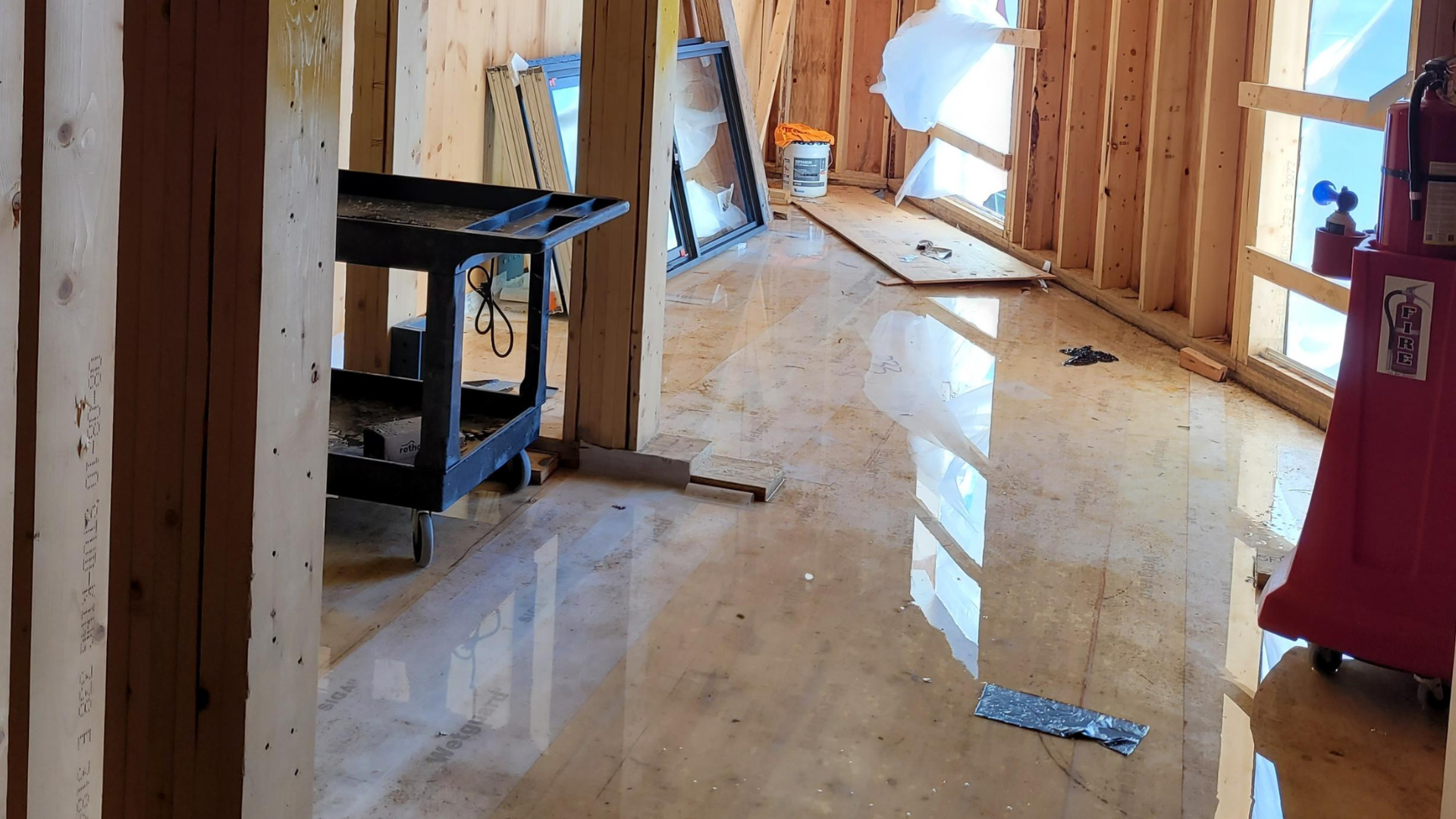
When it comes to construction, temperature and humidity aren’t just comfort factors, they directly impact how materials perform, cure, and bond. Small variations can cause drywall to crack, flooring to warp, or adhesives to fail.
At Polygon, we talk a lot about how maintaining proper environmental conditions throughout a project helps protect quality, reduce rework, and stay on schedule. Some clients provide us with exact specifications, while others want advice on what makes sense for their project and level of risk.
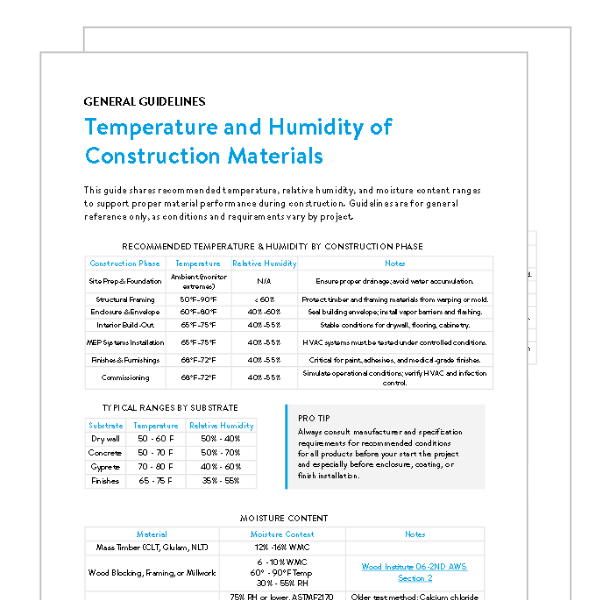
In the case of the latter, it is helpful to review guidelines on recommended ranges for different construction phases and materials and explain why they matter.
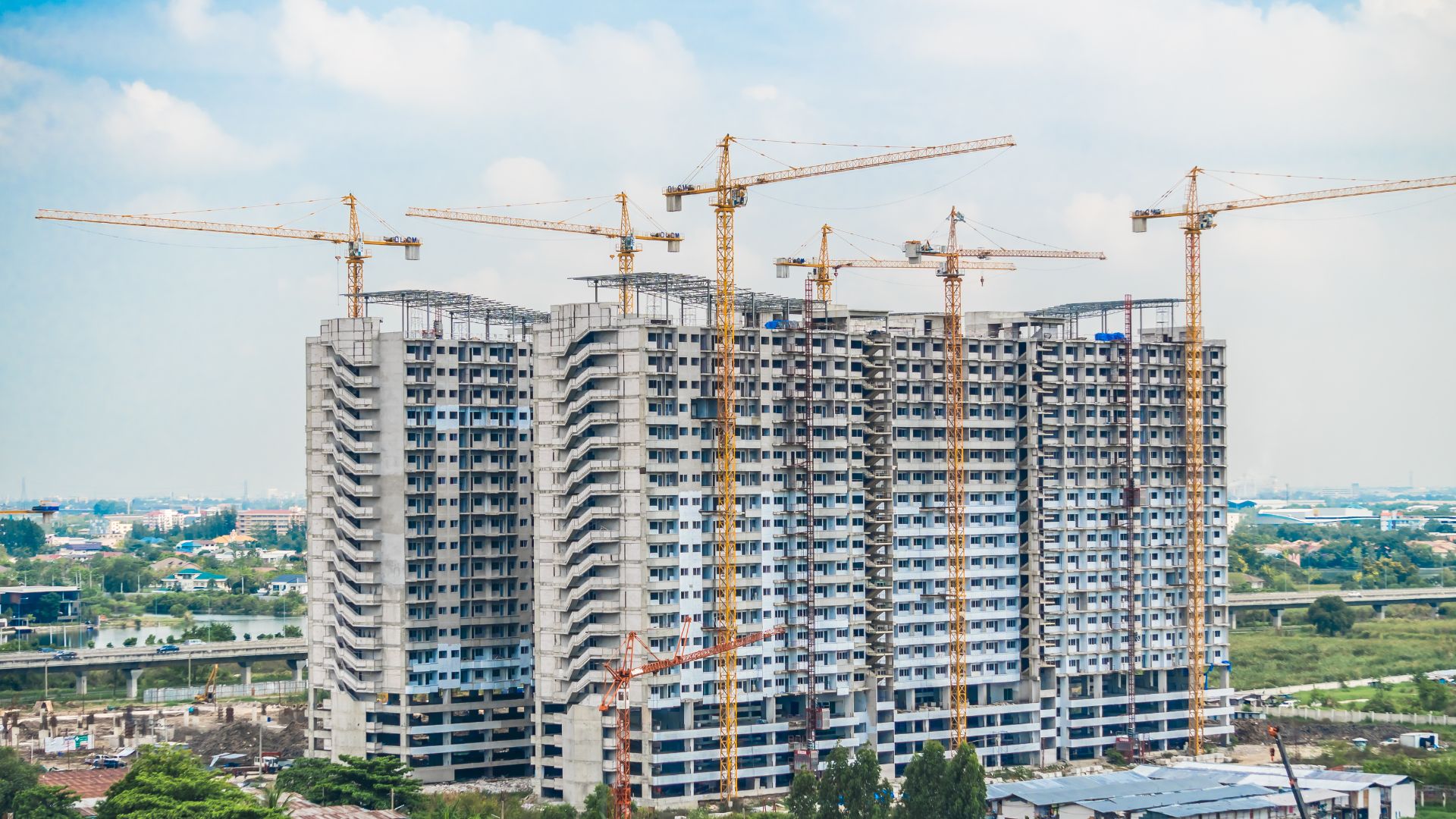
Every stage of construction brings new materials with different variables. Early on, the focus is on preventing moisture buildup and stabilizing the structure. Later, the finishes demand tighter control to ensure lasting quality and schedule assurance.
Maintaining target ranges helps ensure materials perform as designed, maintain manufacturers' warranties, and reduce costly rework caused by environmental damage.
|
Construction Phase |
Temp (°F) |
RH % |
Notes |
|---|---|---|---|
|
Site Prep & Foundation |
Ambient |
n/a |
Ensure proper drainage; avoid water accumulation. |
|
Structural Framing |
50-90°F |
<60% |
Protect timber and framing materials from warping or mold. |
|
Enclosure & Envelope |
60-80°F |
40-60% |
Seal building envelope; install vapor barriers and flashing. |
|
Interior Build-Out |
65-75°F |
40-55% |
Stable conditions for drywall, flooring, and cabinetry. |
|
MEP Systems Installations |
65-75°F |
40-55% |
HVAC systems must be tested under controlled conditions. |
|
Finishes & Furnishings |
68-72°F |
40-55% |
Critical for paint, adhesives, and medical-grade finishes. |
|
Commissioning |
68-72°F |
40-55% |
Simulate operational conditions: verify HVAC and infection control. |
Beyond overall project phases, each substrate also has its own ideal environmental window to ensure proper curing, adhesion, and dimensional stability.
Maintaining these conditions minimizes cracking, delamination, and surface defects that can compromise finish quality. Always check with manufacturers’ requirements well in advance.
|
Substrate |
Temp (°F) |
RH % |
|
Dry Wall |
50° - 60°F |
40% - 50% |
|
Concrete |
50° - 70°F |
50% - 70% |
|
Gypcrete |
70° - 80°F |
40% - 60% |
|
Finishes |
65° - 75°F |
35% - 55% |
Temperature and humidity control are only part of the equation; moisture content within materials may also be a factor. Excess moisture in substrates like wood, gypsum, or concrete can delay curing, weaken adhesives, cause dimensional changes, and promote mold growth. Measuring and verifying moisture content before installation helps confirm that materials are ready for finishes and flooring.
|
Material |
Recommended |
Notes |
|---|---|---|
|
Mass Timber |
12% -16% WMC |
|
|
Wood Blocking, Framing, or Millwork |
6 - 10% WMC |
|
|
Concrete Slabs & Substrates |
75% RH or lower, ASTMF2170 |
Older test method: Calcium chloride test range 3-5lbs, ASTMF1869 |
|
Structural Steel |
Dew point spread of |
Using surface probe |
Always consult manufacturer and specification requirements before enclosure, coating, or finish installation.
Each finish reacts differently to moisture and temperature. Here’s a quick reference to help guide installation and prevent environmental stress on materials:
|
Interior Finish |
Temp (°F) |
RH % |
Notes |
|
Millwork/Casework |
60-80°F |
30%-50% |
AWI 200 standard; RH must remain within range for no more than 24 hrs outside limits. |
|
Wood Veneer Panels |
60-80°F |
30%-50% |
Sensitive to RH fluctuations; prone to warping. |
|
Solid Wood Trim |
60-80°F |
30%-50% |
Moisture content must be stable before install. |
|
Laminate Surfaces |
60-90°F |
30%-55% |
Substrate (often wood) still sensitive to RH changes. |
|
Acoustic Ceiling Panels |
60-85°F |
30%-60% |
RH affects sagging and dimensional stability. |
|
Gypsum Wallboard |
≥ 55°F |
≤ 60% during drying phase |
Lower RH accelerates drying; avoid below 30% to prevent cracking. |
|
Flooring (Wood) |
60-80°F |
35%-55% |
Acclimatize flooring to site conditions before install. |
|
Flooring (Resilient/Vinyl) |
≥ 65°F |
≤ 75% |
Manufacturer specs vary; consult product data sheets. |
|
Carpet (Broadloom/Tile) |
≥ 65°F |
40%-60% |
RH affects adhesive curing and backing stability. |
|
Wallcoverings (Vinyl/Textile) |
≥ 60°F |
40%-60% |
RH affects adhesion and dimensional stability. |
|
Paint & Coatings |
≥ 50°F |
≤ 70% |
RH affects drying time and finish quality. |
|
Tile (Ceramic/Porcelain) |
≥ 50°F |
≤ 70% |
RH affects mortar and grout curing. |
|
Glass Partitions |
No strict temp range |
≤ 60% |
RH affects sealant and adhesive performance. |
|
Metal Panels/Trim |
No strict temp range |
≤ 60% |
RH affects corrosion risk and adhesive bonding. |
Pro Tip: Always acclimate finish materials to jobsite conditions before installation. Sudden exposure to high or low humidity can permanently alter material dimensions. Review the specifications of all your material providers and build a table to better understand the boundaries of our environmental specs.
Just as temperature and humidity shape performance, moisture content inside the substrate itself is equally critical. Materials like concrete, gypsum, and wood must reach proper moisture levels before finishes or flooring are installed. Otherwise, they can warp, crack, trap mold, or fail to bond. Verifying moisture content, not just ambient conditions, helps ensure durability, warranty compliance, and a high-quality finish.
Even brief swings in temperature or humidity can cause finishes to fail, materials to warp, or adhesives to lose strength. These issues often show up late in the project when fixes are most disruptive.
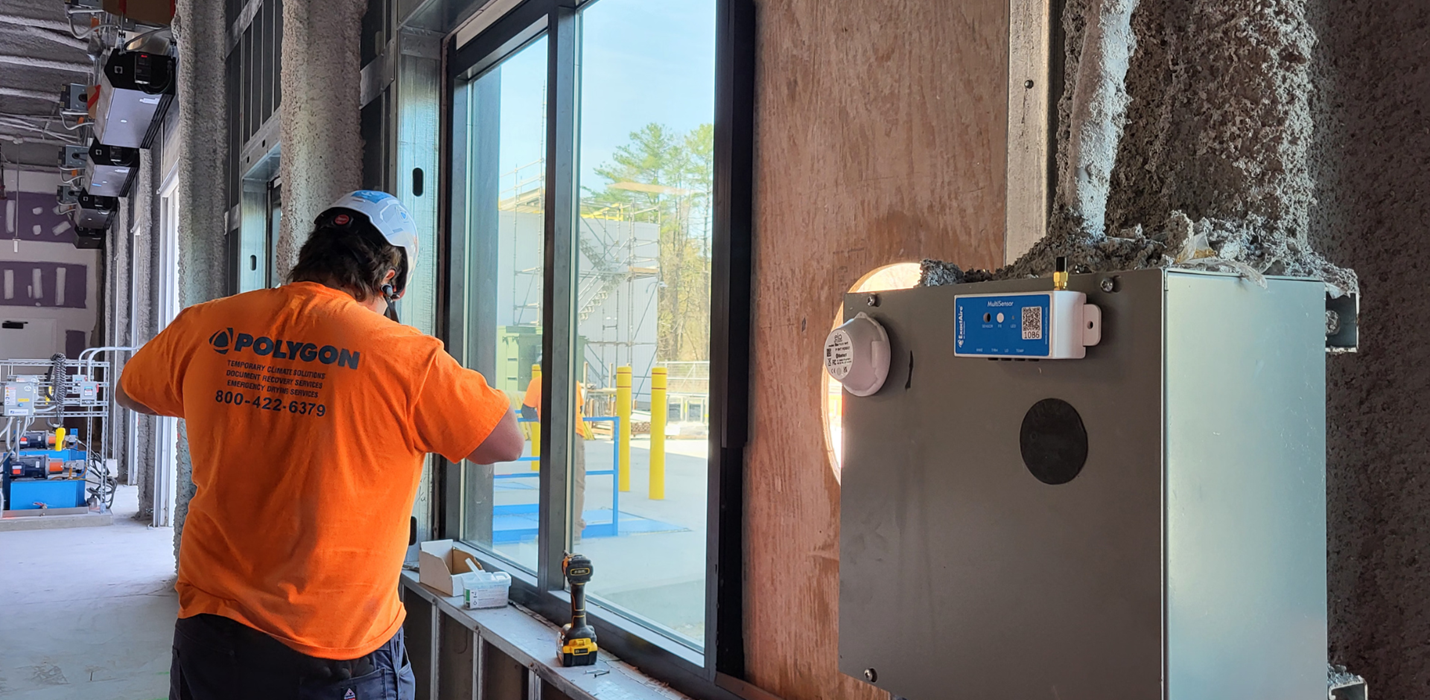
With continuous monitoring and automated control, teams can maintain stable site conditions and catch problems early. Polygon’s remote monitoring provides real-time visibility into temperature and humidity levels, helping ensure every phase stays within specification.
Consistent control protects materials, supports quality results, and keeps construction moving smoothly from start to finish.
Learn how Polygon can help protect your next project.

Emergency Support
1-800-422-6379Send an email
us_info@polygongroup.com24/7 Hotline
Urgent equipment and operational support
Property damage
Documents and contents damage
24/7 Emergency:
United States: 1-800-422-6379
Canada: 1-888-702-4782
Your questions and comments are important to us. Please send us your information with a description of your needs and we will connect with you promptly.
Polygon US Headquarters
15 Sharpners Pond Road, Building F North Andover, MA 01845
Phone: 1-800-422-6379
See all our US locations here: Polygon US office locations
For global support, please contact one of our offices listed here: Our Global offices - Polygon Group