Notice
You are now leaving Polygon Restoration's website and will be directed to another country in the group.
Do you want to proceed?
Notice
You are now leaving Polygon Restoration's website and will be directed to another country in the group.
Do you want to proceed?
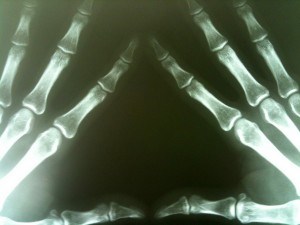
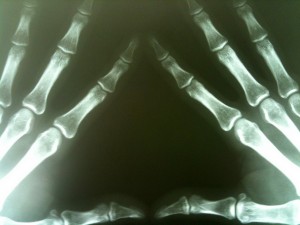
Films—such as x-rays and negatives—are sensitive to temperatures, relative humidity levels and water. X-rays have a base, or plastic backing, and emulsion. The emulsion toughens under light and makes the image more durable. Unlike true emulsions, those used for films are a suspension of solid particles in a gelatin solution. When a medical facility suffers water damage that affects films, x-ray restoration is critical to preserving valuable patient information.
Photographic emulsions are light-sensitive coatings on film made up of grains of micron-sized silver halide or bromide crystals suspended in a gelatin. When you expose the photosensitive crystals to light, they undergo a chemical change that allows images to appear on bases.
The atoms in the silver crystal contain a positive ion with a missing electron. Each bromine or halide particle has a negative ion and an extra electron. Upon exposure to light, the photons remove the extra electron from the bromide or halide ions, allowing it to wander in the crystal. The electron then gets trapped in a crystal’s lattice flaw. The same also happens to some of the silver ions. The trapped electron creates a negative electric field that attracts a positive silver ion to it. When the electron and ion meet, they form a neutral silver atom, forming the beginning of a latent image. This process occurs several times until there is a group of four to six neutral silver atoms, a cluster that’s big enough to become a fully formed latent image.
When you expose the silver atoms to developing chemicals, the crystals form grains of metallic silver, and the original cluster of atoms increases in size. The more light exposure to the silver atoms, the darker the image.
When water comes in contact with an x-ray, bacteria begin to grow, creating an environment that’s conducive to mold growth. At first, the film changes to color, acquiring a bluish or purplish hue. As the gelatin in the emulsifier dissolves, the film feels slippery. As water damage progresses, an x-ray emulsion separates from the base, eventually becoming a gray, soupy substance.
When Polygon arrives on the scene, specialists will carefully pack the x-rays and transport them in a climate-controlled vehicle to a secure drying facility. Technicians then use a special solution to hand-clean the films gently before rinsing them. The x-rays then hang in a climate-controlled environment to air dry. To learn more about x-ray restoration or to receive assistance with creating a preparedness and restoration plan for your medical charts, contact Polygon today.

Emergency Support
1-800-422-6379Send an email
us_info@polygongroup.com24/7 Hotline
Urgent equipment and operational support
Property damage
Documents and contents damage
24/7 Emergency:
United States: 1-800-422-6379
Canada: 1-888-702-4782
Your questions and comments are important to us. Please send us your information with a description of your needs and we will connect with you promptly.
Polygon US Headquarters
15 Sharpners Pond Road, Building F North Andover, MA 01845
Phone: 1-800-422-6379
See all our US locations here: Polygon US office locations
For global support, please contact one of our offices listed here: Our Global offices - Polygon Group