Notice
You are now leaving Polygon Restoration's website and will be directed to another country in the group.
Do you want to proceed?
Notice
You are now leaving Polygon Restoration's website and will be directed to another country in the group.
Do you want to proceed?
After an appraiser was asked to evaluate the American Bible Society’s Rare Book Collection, he came to an alarming discovery — an active mold outbreak was attacking more than 1,100 irreplaceable volumes. Located in New York City, the Library is the largest collection of Bibles in North America, with 4,700 volumes, which includes rare bibles dating back to the 13th century. More than 300 languages are represented in the Rare Book Collection, including early printed Bibles and a small collection of manuscripts.
Prominent books include the first edition of the 1611 King James Bible, William Tyndale’s Pentateuch of 1530, the Coverdale Bible of 1535, and Martin Luther’s German translation of the Bible from 1522-1534. The collection also is rich in the first translations of Scripture in Native American languages, including the first bible printed in the New World (Eliot’s Indian Bible of 1663) and the only Scripture ever published in the Delaware language, dating from 1818.
PROBLEM
With the mold outbreak, the rare collection was in immediate jeopardy. John Colligan, director of building management services at the American Bible Society, recalled that stressful day. Dorothea Colligan, the Library’s conservator, appeared at his office door, exclaiming, “We have a problem; we have mold!”
The mold, which mainly appeared on the surface of the bibles, was the result of a defect in the second-floor HVAC system that raised humidity levels in the Rare Book Room. The moisture inside the room activated spores that are found in common dust particles. “The bibles require precise temperature and humidity control and a failure of the ambient control system caused air to be improperly distributed throughout the entire room,” said John Colligan. “Thankfully, we caught the outbreak early enough so that mold growth was limited to the surface of the bibles.”
SOLUTION
The Bible Society immediately activated its disaster recovery plan, they contacted Polygon and Paul Himmelstein, a conservator with a specialty in museum environmental control and collections management. An environmental firm was also called in to test the air in the Rare Book Room to determine if the mold situation was harmful to people.
“When we learned the air was safe, we immediately moved forward with the mold remediation plan,” said Colligan.
Working together, Himmelstein and Polygon devised a methodology to preserve precious books. The program for cleaning the affected bibles included cleaning the mold spores with non-metal bound archival brushes, dehumidifiers, refrigeration equipment, variable speed HEPA vacuums, and the establishment of temporary remediation, transition, and containment areas.
First, every book was tagged with a location number, and each shelf was marked with a numerical tag so that proper shelf locations could be maintained. A self-contained remediation area was constructed within the Rare Book Room. Inside the remediation area variable speed, archival grade HEPA vacuums, and traditional air scrubbers removed the mold spores from the air. While dehumidifiers and refrigerants maintained temperatures between 69 and 72 degrees and relative humidity between 35 and 40 percent.
Our team used non-metal bound brushes to brush the mold spores off the outside of the books toward a HEPA vacuum to prevent flaking.
“Some of our bibles are quite worn and fragile, so the remediation process was time-consuming and difficult,” said Dorothea Colligan.
Once all surfaces of a book were cleaned which included the inside covers, it was carefully transferred into a transition chamber, a clean space that was constructed, and placed on a fiberglass cart. After final remediation in the transition chamber, Polygon personnel from outside the transition area placed the bibles on another cart and wheeled it to a containment area constructed outside the Rare Book Room.
The containment area consisted of five rows of shelves encircled by six-millimeter polyethylene plastic, traditional air scrubbers to clean the air, and a dehumidifier to control ambient conditions. Workers placed each bible on a shelf corresponding to its original location in the Rare Book Room. To ensure continuity, we recreated the shelving in the containment area so that every bible was put back in its original location.
“The mold remediation project was a monumental and detailed task that lasted four weeks. Polygon was certainly up to the challenge,” said John Colligan. “Including them in our disaster recovery plan was a big benefit. This unfortunate event has allowed us to redesign the room and install an HVAC system that is more appropriate for rare books.”
After the project work was completed, Polygon equipment controlled ambient conditions inside the containment area while the old system was being replaced.
“Polygon was very efficient and adaptive at applying its standard process to the instructions of a consultant conservator,” said Dorothea Colligan. “They did a terrific job making sure all of the books were cleaned and safely returned to their original place.”
RESULTS
With Polygon written into the ABS’s disaster plan, the Society received priority service. We were quick to respond, beginning work immediately after being called.
Full Services
Polygon has handled many large book and document restoration projects. ABS received service from trained document conservators, a fleet of drying and air treatment equipment, and the ability to work on-site or move documents to a Polygon facility.
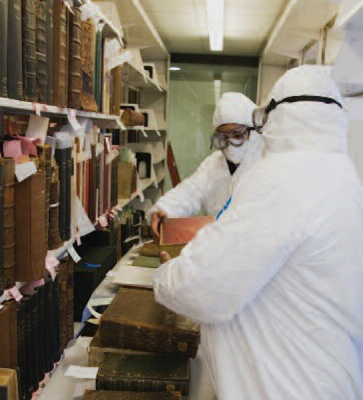
Polygon created temporary storage and processing facilities for the collection, allowing restored volumes to be segregated from those still contaminated. Once the collection was completely restored, Polygon engineered and provided a rental HVAC system to protect the volumes. This preserved the restored books while a permanent climate control system could be specified and installed.
“Polygon was very efficient and adaptive at applying its standard process to the instructions of a consultant conservator. They did a terrific job making sure all of the books were cleaned and safely returned to their original place.”

Emergency Support
1-800-422-6379Send an email
us_info@polygongroup.com24/7 Hotline
Urgent equipment and operational support
Property damage
Documents and contents damage
24/7 Emergency:
United States: 1-800-422-6379
Canada: 1-888-702-4782
Your questions and comments are important to us. Please send us your information with a description of your needs and we will connect with you promptly.
Polygon US Headquarters
15 Sharpners Pond Road, Building F North Andover, MA 01845
Phone: 1-800-422-6379
See all our US locations here: Polygon US office locations
For global support, please contact one of our offices listed here: Our Global offices - Polygon Group