Notice
You are now leaving Polygon Restoration's website and will be directed to another country in the group.
Do you want to proceed?
Notice
You are now leaving Polygon Restoration's website and will be directed to another country in the group.
Do you want to proceed?

In food and beverage manufacturing, environmental control is directly tied to food safety, regulatory compliance, and operational continuity. Temperature and humidity work together, and when they aren’t properly managed, they create condensation, one of the most common and overlooked environmental risks in USDA-regulated facilities.
Condensation forms when warm, moisture-laden air meets colder surfaces, a common condition in food manufacturing environments where chilled rooms, freezers, washdown areas, and ambient processing zones operate side by side.
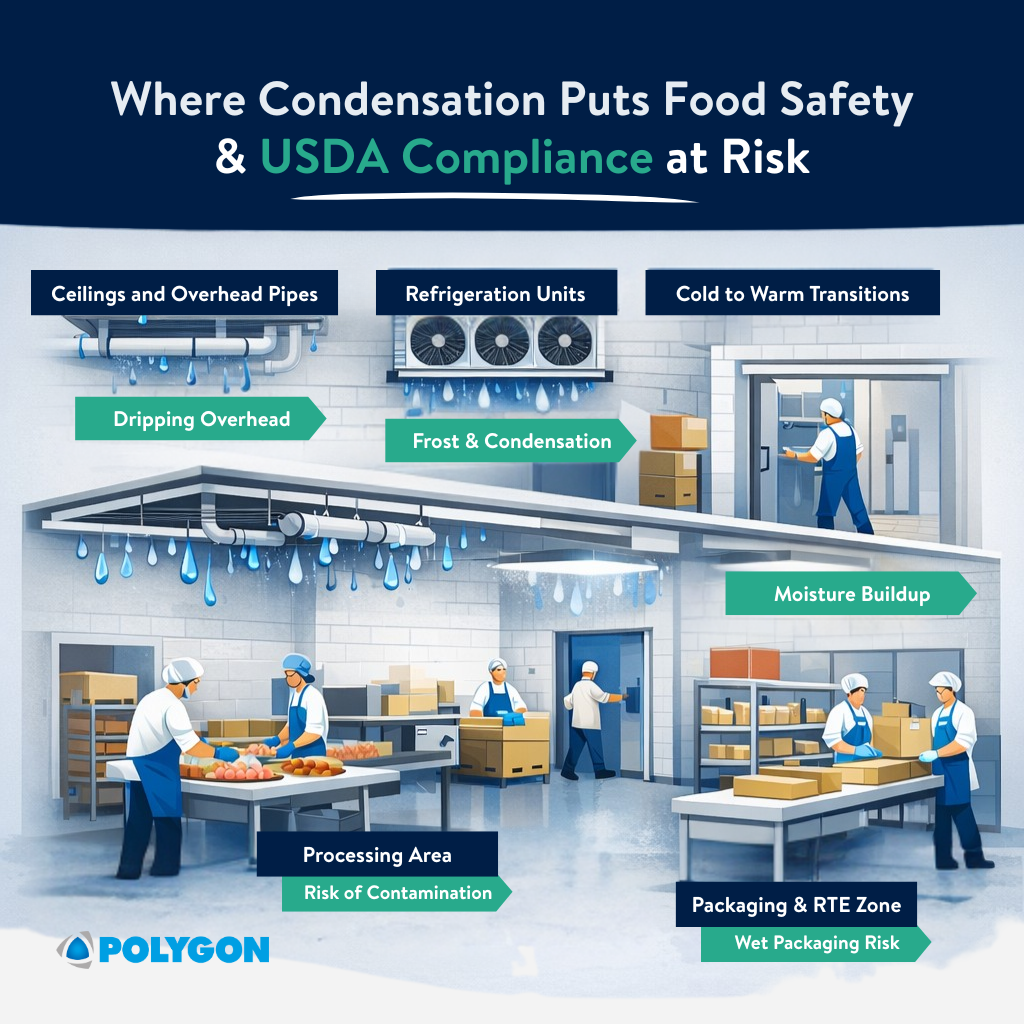
Ceilings, overhead piping, refrigeration lines, cold-to-warm transition areas, and RTE processing and packaging zones are especially vulnerable. What may begin as minor moisture buildup can quickly escalate into a food safety, regulatory, and operational concern, creating slip hazards, increasing contamination risk, and raising USDA compliance issues that can disrupt production schedules.
From a USDA perspective, condensation is not considered a cosmetic or routine maintenance issue. It is viewed as an indicator of lost environmental control and a direct risk of contamination in exposed processing and packaging areas. Inspectors frequently associate visible moisture with insanitary conditions or inadequate preventive controls, even when the issue is intermittent rather than constant. If left unaddressed, condensation findings can escalate into corrective actions, increased inspection scrutiny, or production disruptions.
Beyond compliance, uncontrolled humidity and condensation have a measurable impact on day-to-day plant performance. Excess moisture can:
Over time, these issues increase operational costs and reduce overall throughput, quietly impacting the bottom line.
Preventing condensation in food manufacturing environments requires a proactive, engineered approach rather than reactive fixes. Temperature, humidity, and airflow must be managed together, particularly in high-risk production, cooling, and storage zones. When these conditions are stabilized, the risk of condensation is reduced at the source.
Polygon works with food and beverage manufacturers to help maintain environmental conditions that align with food safety objectives and USDA expectations. Through targeted temperature and humidity control and real-time environmental monitoring, facilities gain early visibility into changes that could lead to condensation. This allows teams to address risk before it becomes a compliance finding or operational disruption.
When environmental conditions are properly controlled, condensation shifts from an ongoing threat to a managed variable. Facilities gain stronger food safety programs, greater confidence during USDA inspections, and more consistent operations. For food manufacturers, managing temperature and humidity together is not optional; it’s essential to protecting product, compliance, and production continuity.
Polygon helps food and beverage manufacturers stabilize environmental conditions through targeted control and real-time monitoring, reducing risk before it impacts operations or compliance. Learn more about how Polygon supports food manufacturing environments.

Emergency Support
1-800-422-6379Send an email
us_info@polygongroup.com24/7 Hotline
Urgent equipment and operational support
Property damage
Documents and contents damage
24/7 Emergency:
United States: 1-800-422-6379
Canada: 1-888-702-4782
Your questions and comments are important to us. Please send us your information with a description of your needs and we will connect with you promptly.
Polygon US Headquarters
15 Sharpners Pond Road, Building F North Andover, MA 01845
Phone: 1-800-422-6379
See all our US locations here: Polygon US office locations
For global support, please contact one of our offices listed here: Our Global offices - Polygon Group