Notice
You are now leaving Polygon Restoration's website and will be directed to another country in the group.
Do you want to proceed?
Notice
You are now leaving Polygon Restoration's website and will be directed to another country in the group.
Do you want to proceed?

Université Laval conducted a durability study for Parc du Massif du Sud, a regional park in Quebec that offers hiking, camping, and wood-frame chalet accommodations, in collaboration with Goodfellow, a Canadian manufacturer and distributor of lumber, engineered wood products, and mass timber components, and Latéral, a Montreal-based structural engineering consulting firm specializing in mass timber. The study evaluated the performance of various coating and protection systems applied to hybrid glued-laminated timber (glulam) beams intended for exterior exposure.
Led by Professor of Timber Engineering Alexander Salenikovich, eng., Ph. D., alongside Master's Student Coralie Offroy, the two-month research program compared different wood coatings by monitoring moisture content, modulus of elasticity (MOE), and visible signs of deterioration under cyclic environmental conditions simulating accelerated exterior exposure. The objective was to evaluate the coatings' effectiveness in enhancing timber durability and long-term performance.
The Université Laval research team required continuous and accurate moisture monitoring throughout a durability study conducted for Parc du Massif du Sud. The study involved twelve hybrid glued-laminated timber (glulam) beams composed of a Douglas fir-larch structural core and sacrificial Western Red Cedar laminations. Four test groups were established to compare the effects of sacrificial lamination thickness and protective coating systems under alternating wet and dry climate cycles inside a controlled conditioning chamber.
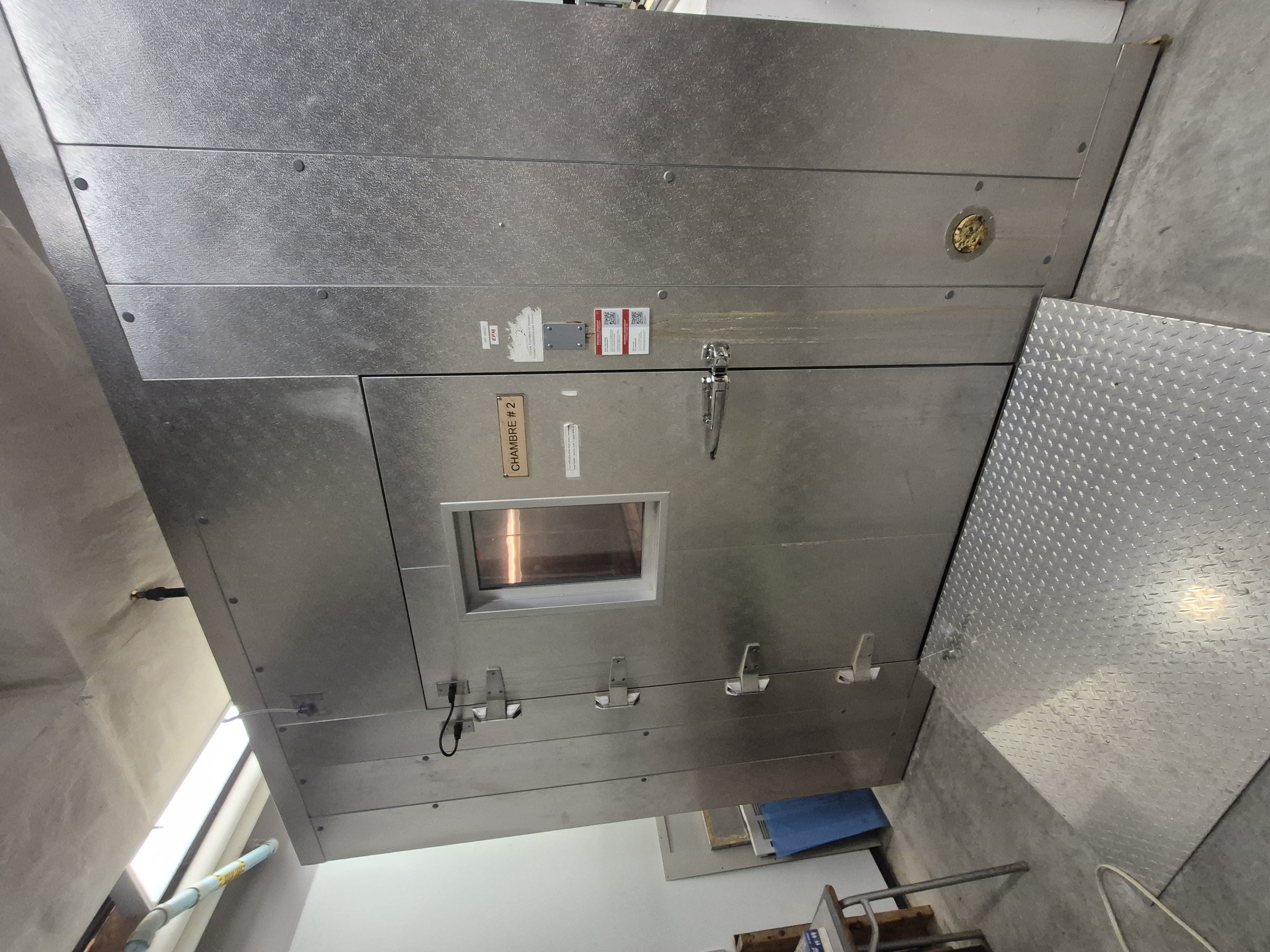
The applied cycles consisted of an 8-hour wet phase at 95% relative humidity and 25°C, followed by a 16-hour dry phase at 40% relative humidity and 40°C. Researchers aimed to evaluate potential delamination in glued interfaces or any surface checking and cracking, monitor changes in the beams’ apparent modulus of elasticity (MOE) under varying climate conditions, and compare the performance of different coating systems and sacrificial layer configurations.
To better understand how moisture fluctuations impacted the beams throughout the testing process,
the team needed a reliable way to continuously monitor internal wood moisture conditions.
Université Laval connected with Polygon during the planning phase of the project, allowing continuous monitoring to be integrated into the study from the beginning rather than relying on conventional manual measurements using pins or standalone data loggers. Polygon provided 12 Multi Sensors to continuously monitor internal wood moisture conditions throughout the environmental conditioning cycles. The sensors were installed approximately 32 millimeters into each beam at a location 16 inches (406 mm) from the beam end, allowing them to capture moisture behavior from within the timber rather than relying only on surface-level or periodic manual readings.
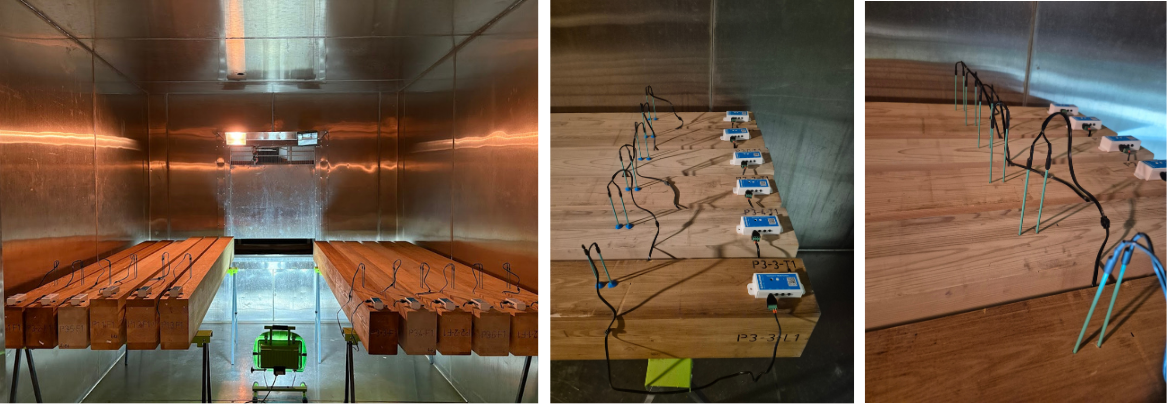
“Without the Polygon Multi Sensors, we likely would have relied on standalone data loggers and periodic manual moisture measurements,” explained Coralie Offroy, Master’s Student at Université Laval.
Over the two-month testing period, the sensors continuously recorded humidity conditions while the Université Laval team carried out repeated modulus of elasticity testing and mass measurements at different stages throughout the experiment. Together, these data points helped researchers compare how the different coating systems and sacrificial layer configurations performed under simulated exterior conditions.
Polygon’s online user interface provided real-time visibility into sensor activity through dashboards and alerts, making it easy to review measurements throughout the study.
“The dashboards allowed real-time verification of sensor operation at any moment during the experimental program.”
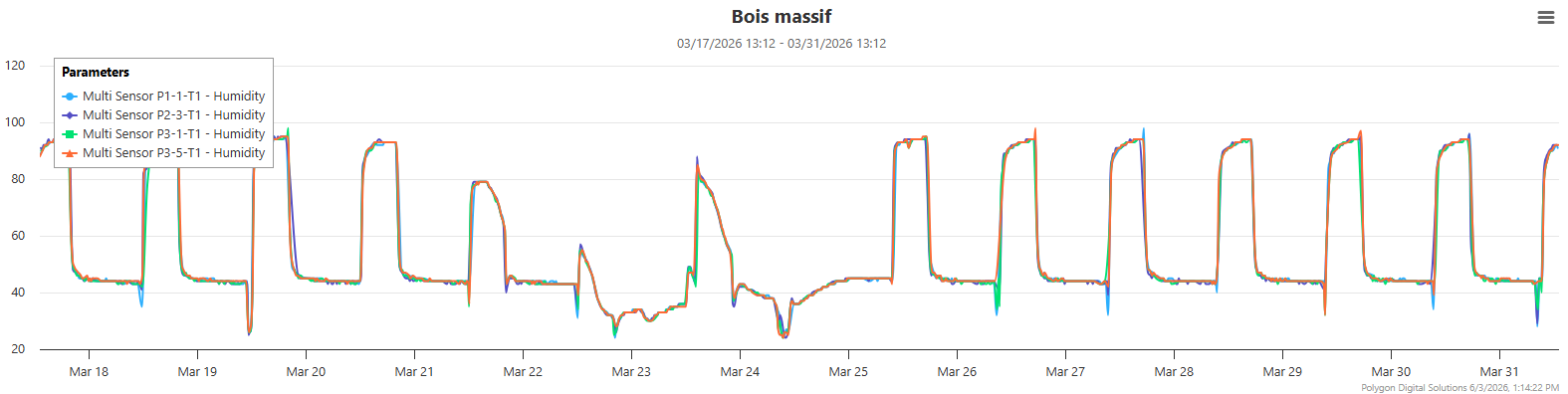
By accessing the data, researchers could quickly visualize sensor readings and short-term trends for each beam through graphical displays showing temperature and humidity variations over previous days. This visibility allowed the team to track evolving conditions throughout the study and confirm that sensors were functioning properly during the entire monitoring period.
Throughout the project, Polygon also provided ongoing technical support and collaboration to help ensure the success of the monitoring program.
“The communication and technical support provided throughout the project were excellent,” added Offroy. “The collaboration with Polygon contributed positively to the success of the project.”
The continuous moisture monitoring data collected throughout the study helped researchers evaluate the performance of different coating systems and sacrificial layer configurations under simulated exterior exposure conditions. Key findings from the study included:
Following the initial testing phase, Université Laval is continuing their research by placing beams outside under real exterior conditions. Four Multi Sensors are being used outdoors to monitor beam performance throughout the summer as part of the ongoing research program.
Learn more about how Polygon can support your mass timber project with moisture management solutions, or contact our team to discuss your next project.

“Without the Polygon Multi Sensors, we likely would have relied on standalone data loggers and periodic manual moisture measurements.”
Master's Student, Université Laval

Emergency Support
1-800-422-6379Send an email
us_info@polygongroup.com24/7 Hotline
Urgent equipment and operational support
Property damage
Documents and contents damage
24/7 Emergency:
United States: 1-800-422-6379
Canada: 1-888-702-4782
Your questions and comments are important to us. Please send us your information with a description of your needs and we will connect with you promptly.
Polygon US Headquarters
15 Sharpners Pond Road, Building F North Andover, MA 01845
Phone: 1-800-422-6379
See all our US locations here: Polygon US office locations
For global support, please contact one of our offices listed here: Our Global offices - Polygon Group