Notice
You are now leaving Polygon Restoration's website and will be directed to another country in the group.
Do you want to proceed?
Notice
You are now leaving Polygon Restoration's website and will be directed to another country in the group.
Do you want to proceed?

Skanska, a leading global construction and development company is committed to achieving Net Zero carbon emissions and climate neutrality by 2045. Having already reduced operational carbon emissions by 61% between 2015 and 2025, the company is targeting deeper, incremental reductions across its projects.
Temporary climate control is critical for quality assurance and schedule certainty for its projects, especially in critical regions where temperature and humidity fluctuations affect finishes and moisture-sensitive materials.
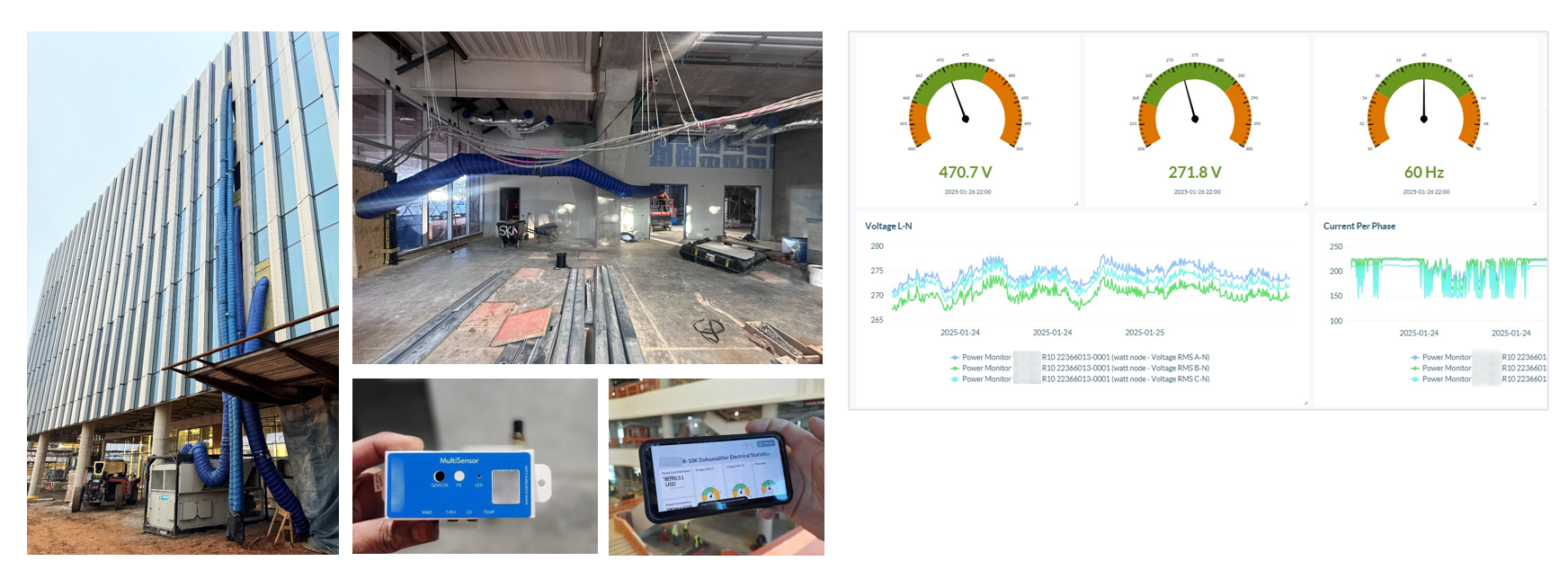
Skanska’s team partnered with Polygon to test IoT-enabled monitoring and control technology aimed at reducing the energy footprint of climate control equipment during construction.
Traditional methods of managing climate and controlling moisture on construction sites include running high-power equipment and using antiquated methods of climate data collection. Polygon’s technical solution offers a more advanced approach where sensor data can inform equipment to turn on and off based on real-time conditions running only when necessary. National Carbon Manager, Mark Chen, and Senior Sustainability Director, Tolga Tutar, recognized the potential energy savings and carbon emission avoidance that could be delivered at scale but needed demonstrated results to drive adoption. They worked with Brian Carter’s project team in Texas to showcase Polygon’s potential benefits on a medical education building project.
 “Quality control is a principal benefit of temporary climate control. We have multitudes of materials and finishes in a building all with different ranges of required humidity and temperature at installation,” Chen points out. “That is why we use it so much on our mass timber projects. But if we can save energy and electricity without a lot of cost that is a superior solution project teams could use on any project.”
In February 2025, the Skanska project team was closing up the 248,000 square foot medical education building and preparing the space for interior finishes. Polygon’s dehumidification equipment and sensors were already onsite managing interior temperatures and humidity.
 Project Executive, Brian Carter explained, “Moisture conditions with concrete structural slabs are a constant here in Texas, sometimes affecting 75% of the building slabs. That’s why it’s critical to condition the building as early as possible so we can mitigate any moisture issues before the installation of finishes, specifically flooring. The Polygon system helps us reduce moisture in the building, control humidity and temperature, protect finishes and keep the project on schedule.”
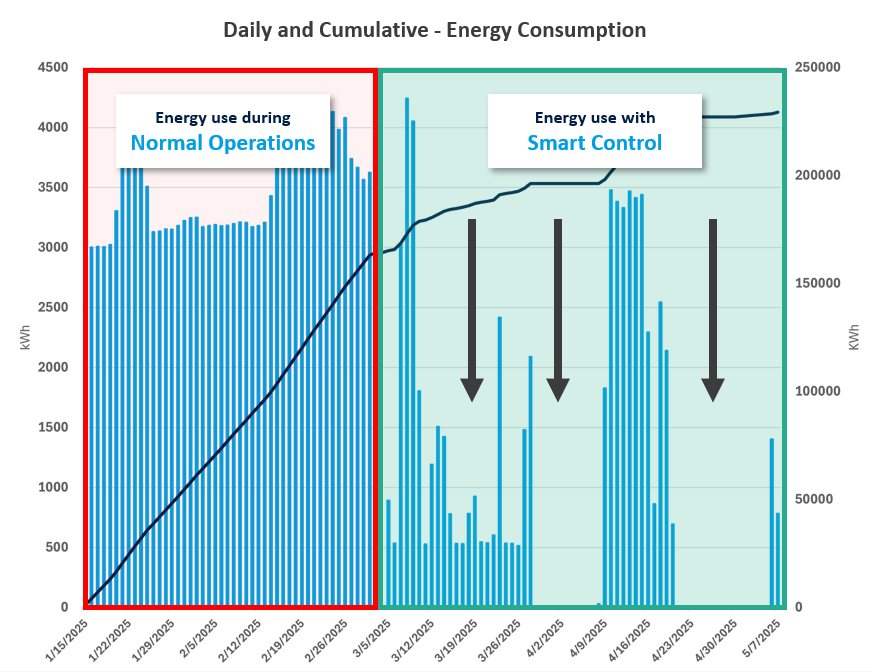
To quantify energy consumption levels under a normal scenario, Polygon installed a power monitor on one of the desiccant dehumidifiers. It ran nearly 24/7 for 49 days. Then in March, Polygon added a smart controller allowing it to automatically turn on and off according to the project team’s target specs. It modulated for 64 days. The power levels were observed in a live dashboard and then later exported for further analysis.
The kilowatt-hour trend before and after controls were installed are visualized in the chart below. It is important to note that the results are for one desiccant dehumidifier and not the entire climate control system. Daily energy consumption for the unit is represented by blue bars
 "While climate control is a small fraction of the construction process, sensors and control systems like Polygon's will be more and more important as we work towards the next phase of our NetZero strategy. This is a small-scale demo in one project, but if you multiply the savings in cost, and reductions in energy use and carbon emissions, it becomes significant in the portfolio across the company and it positively contributes to our climate goals." Tolga Tutar
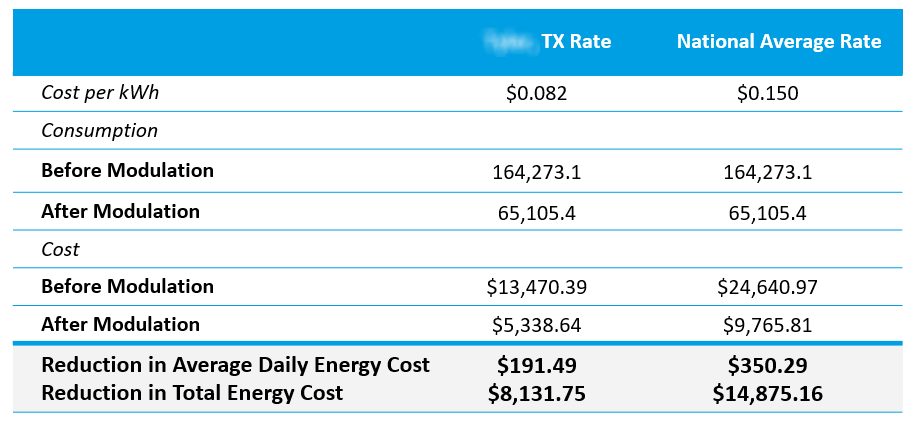
Project Value-Add: The Polygon solution delivered value beyond quality assurance and schedule protection by significantly reducing energy consumption and operational cost.
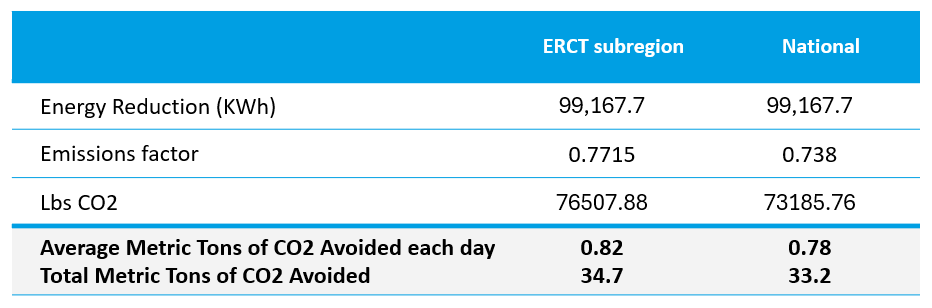
Carbon Avoidance: The smart system resulted in a 70% reduction in average daily energy use and daily carbon emissions. The power monitor provides clear, defensible proof of emissions reduction.
Behavioral Change: Data-driven results build confidence in sustainable practices and accelerate adoption in the field
For more information on Polygon monitoring and climate control solutions visit, http://www.polygongroup.us.
For details on Skanska’s sustainability initiatives, explore their Annual and Sustainability Report 2025 here.
Sources: Electric Rates from ElectricityLocal.com. Emissions factor varies by power source. Emission factors provided by EPA Power Profiler: https://www.epa.gov/egrid/power-profiler#/ERCT. Offsets were calculated using data from https://www.epa.gov/energy/greenhouse-gas-equivalencies-calculator-calculations-and-references

"While climate control is a small fraction of the construction process, sensors and control systems like Polygon's will be more and more important as we work towards the next phase of our NetZero strategy."
Tolga Tutar, Senior Sustainability Director, Skanska

Emergency Support
1-800-422-6379Send an email
us_info@polygongroup.com24/7 Hotline
Urgent equipment and operational support
Property damage
Documents and contents damage
24/7 Emergency:
United States: 1-800-422-6379
Canada: 1-888-702-4782
Your questions and comments are important to us. Please send us your information with a description of your needs and we will connect with you promptly.
Polygon US Headquarters
15 Sharpners Pond Road, Building F North Andover, MA 01845
Phone: 1-800-422-6379
See all our US locations here: Polygon US office locations
For global support, please contact one of our offices listed here: Our Global offices - Polygon Group