Notice
You are now leaving Polygon Restoration's website and will be directed to another country in the group.
Do you want to proceed?
Notice
You are now leaving Polygon Restoration's website and will be directed to another country in the group.
Do you want to proceed?

Water damage is becoming an increasingly visible challenge in aging hospitals across Quebec. Behind the scenes, recurring leaks and infrastructure failures are not only affecting buildings, but also disrupting operations and patient care. As investment focuses on new facilities, the risks within existing hospital environments continue to grow.
Across Quebec, healthcare infrastructure is receiving renewed attention. Major investments are being announced, and new hospital projects are moving forward as part of long-term modernization plans. These developments are necessary and reflect a growing demand for updated, efficient healthcare environments.
At the same time, a large portion of the existing hospital network continues to age. Many facilities are operating well beyond their original design life, and with that comes a different kind of challenge, one that is less visible, but increasingly disruptive.
Water damage is one of the most persistent issues affecting these environments. In a hospital setting, it is rarely contained to a single area. Aging plumbing systems, combined with limited visibility into what is happening behind walls or above ceilings, make early detection difficult. A small, undetected leak can develop over time, eventually leading to material deterioration, damage to equipment, and in some cases, temporary closures of critical spaces.
At the McGill University Health Centre, the Montreal General Hospital alone has recorded 265 water leaks since December 2024, with a maintenance backlog estimated to exceed $250 million. This level of frequency illustrates how water-related incidents are not isolated events, but an ongoing operational challenge, one that directly affects capacity, patient flow, and care delivery. These pressures are not unique to Quebec and are being seen across healthcare infrastructure in all Canadian provinces.
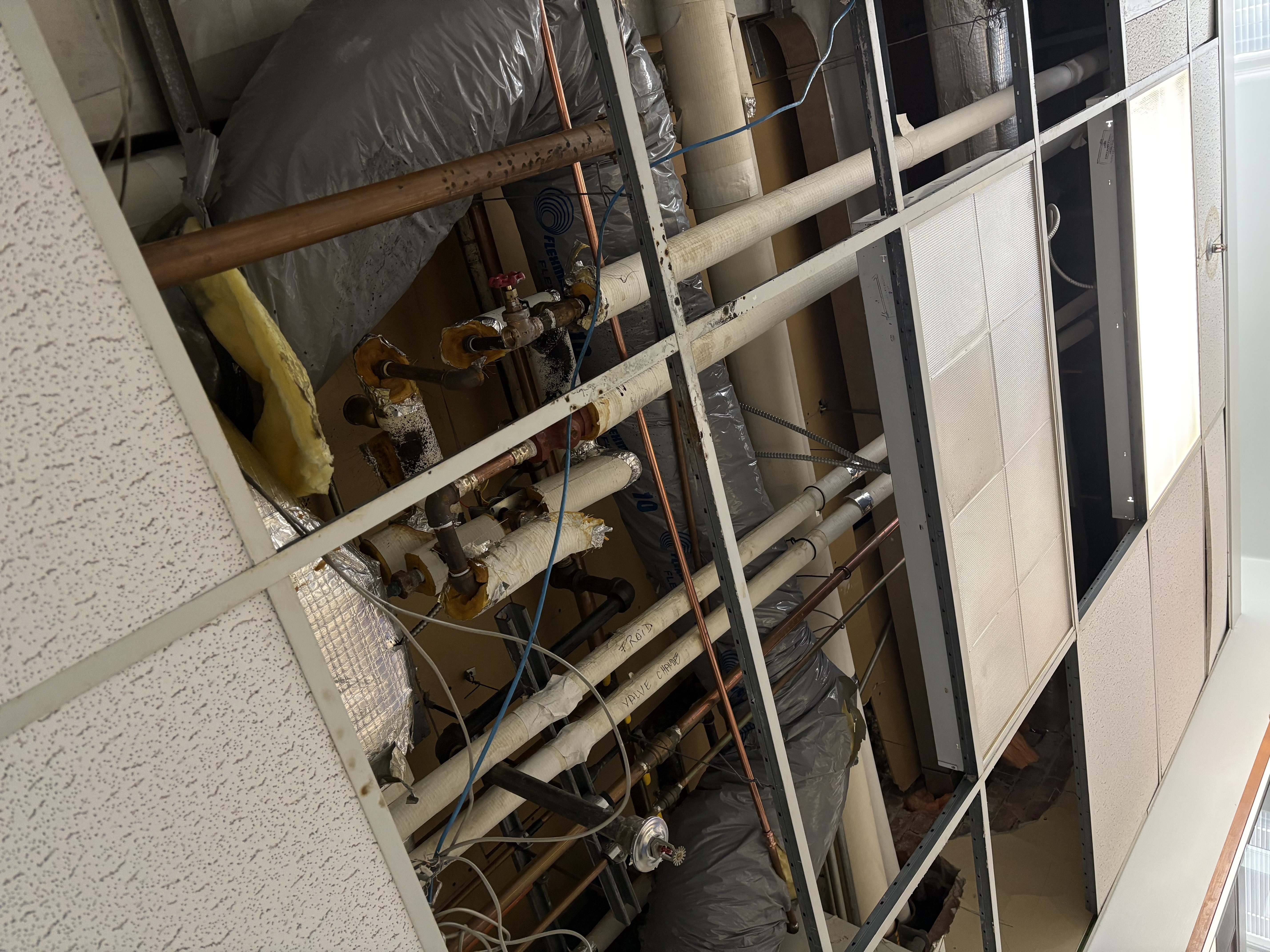 Quebec’s climate adds another layer of pressure on existing hospital properties. Harsh winter conditions, including prolonged freezing temperatures and repeated freeze-thaw cycles, place significant stress on plumbing systems. In older facilities, where pipes may already be weakened by corrosion or years of use, these conditions increase the likelihood of cracks, bursts, and hidden leaks. Freeze-thaw cycles can also accelerate corrosion in cast-iron and other legacy piping systems commonly found in pre-1980s hospitals, further increasing the risk of failure. As temperatures fluctuate, materials expand and contract, accelerating wear and making failures more frequent. In this context, water-related incidents are not only a function of aging buildings, but also of the environment they operate in.
This is where the conversation around infrastructure investment becomes more complex. While new construction is essential, it does not immediately reduce the exposure within existing facilities. Most patients will continue to receive care in buildings that were constructed decades ago, where systems are under increasing strain. Without additional measures, these environments remain vulnerable to recurring losses.
In many healthcare facilities, water issues are often identified only once they become visible. By that point, the duration of the leak has already shaped the extent of the damage. In legacy buildings, where detection often depends on visual signs or occupant reports, that delay can be significant.
Today, technology is allowing healthcare facilities to approach this risk differently. Instead of relying on discovery after the fact, systems can now monitor water activity in real time and identify issues as they occur. Early leak detection plays a central role in this shift. Sensors placed in high-risk areas can detect the presence of water immediately, triggering alerts before damage spreads.
Beyond point detection, in-line water monitoring introduces a broader level of visibility. By tracking water flow continuously within a building’s piping system, it becomes possible to identify unusual patterns that may indicate a leak. Small but continuous losses, often the most difficult to detect in older infrastructure, can be flagged early, allowing intervention before the situation worsens. The impact becomes even more significant when monitoring is combined with automatic shut-off technology. In these systems, abnormal flow can trigger a valve to stop the water supply without the need for manual intervention. This reduces the duration of a leak from hours or days to minutes, significantly limiting the extent of damage and the associated disruption. In many cases, facilities implementing these types of systems have seen meaningful reductions in water damage costs and operational disruption.
In healthcare settings, where continuity of service is directly tied to patient outcomes, this type of response can make a meaningful difference. At the McGill University Health Centre, 60 of the recorded water leaks led to temporary bed closures, while 10 had a significant impact on clinical operations. It also supports broader efforts to maintain safe environments. Excess moisture in hospitals is not only a structural concern but can also affect indoor air quality and contribute to microbial growth. Standards such as CSA Z317.13:22 emphasize the importance of controlling environmental conditions, particularly during construction and maintenance activities within healthcare facilities.
Addressing aging infrastructure is not solely about replacing buildings. It is also about strengthening the resilience of the ones that remain in use. Targeted investments in monitoring and prevention technologies offer a way to reduce risk without requiring large-scale reconstruction. They provide visibility where it did not previously exist and allow facilities teams to respond more quickly and more effectively.
As Quebec continues to invest in its healthcare future, combining new hospital construction with smart prevention strategies in existing facilities will be essential. In many ways, the question is no longer whether water damage can be prevented, but how early it can be detected and how quickly action can be taken once it is.
If your facility is facing these challenges, our team can help develop a tailored water risk management and early detection plan. Connect with us to get started.
Sources

Emergency call 24hr service
1 888 702-4782Send message
ca_service@polygongroup.comDirect Reaction Team
We are ready to respond on short notice to ensure that real estate and other property restored to its origins in the fastest possible way. We do a quick assessment of the damage to be able to take the right actions
Please contact us with your questions or project requirements. We look forward to assisting you.
4565 Metropolitain Est, Montreal, QC, H1R 1Z4
Tel: 514-326-0555 | Fax: 514-326-1444
24/7 Emergency
1-888-702-4782