Notice
You are now leaving Polygon Restoration's website and will be directed to another country in the group.
Do you want to proceed?
Notice
You are now leaving Polygon Restoration's website and will be directed to another country in the group.
Do you want to proceed?

When commissioning a new data center, ensuring optimal air quality is as critical as power and network reliability. One key hazard during this phase is formaldehyde, a volatile organic compound (VOC) commonly released from construction materials, furnishings, and adhesives. Exposure to elevated formaldehyde levels can affect both human health and sensitive equipment, making proactive management essential.
Formaldehyde (CH2O) is a colorless gas with a strong odor that can irritate the eyes, nose, and throat. In a data center, where electronics are densely packed, poor air quality can accelerate corrosion, reduce equipment lifespan, and increase the risk of downtime. During commissioning, construction dust, off-gassing from new materials, and temporary storage of building components can spike formaldehyde levels, creating a need for precise environmental control.
The right climate control setup is key to minimizing formaldehyde exposure during commissioning. Equipment commonly used includes:
Deploying this type of climate-control equipment in temporary or permanent data center environments helps construction teams maintain optimal air quality throughout commissioning.
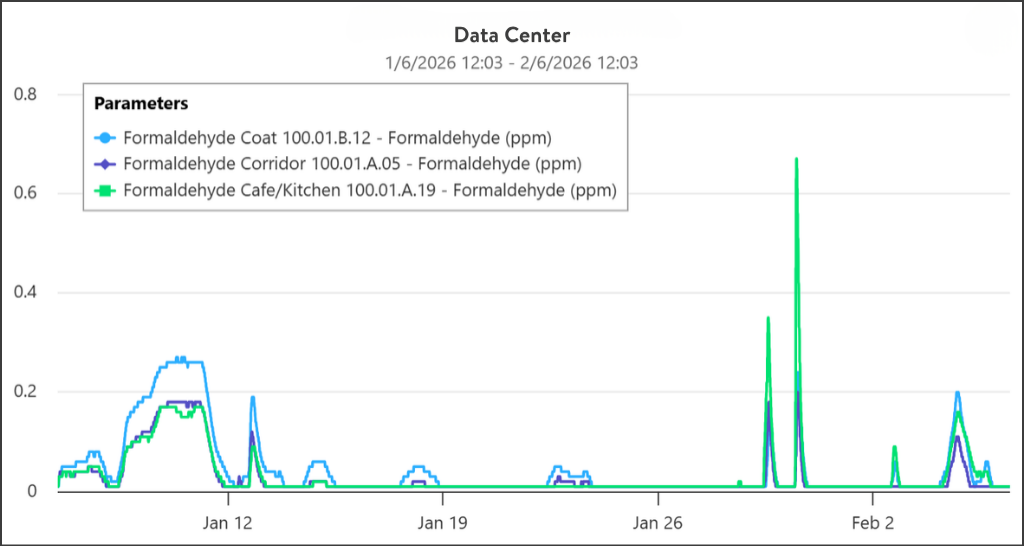
This graph shows a spike in formaldehyde levels following a delivery of construction material. After the alert was triggered, ventilation was increased, successfully reducing formaldehyde exposure levels back to acceptable conditions.
Project teams increasingly rely on IoT-enabled climate control systems for real-time monitoring and remote management:
Polygon’s integrated approach allows teams to monitor, control, and optimize environmental conditions remotely, ensuring strict air quality standards are consistently met while data center equipment remains protected.
Formaldehyde management during data center commissioning is not just a matter of worker safety. It directly affects equipment performance and long-term facility reliability. Using climate control equipment with advanced filtration and integrating remote monitoring and control capabilities allows commissioning teams to manage VOCs, maintain ideal environmental conditions, and ensure a smooth transition from construction to full operation.
By combining thoughtful equipment deployment with IoT-enabled monitoring, data centers can be commissioned safely, efficiently, and with confidence in air quality standards.
Contact Polygon today to learn how our climate control solutions and remote monitoring capabilities keep your environment safe and efficient.
Sources:

Emergency Support
1-800-422-6379Send an email
us_info@polygongroup.com24/7 Hotline
Urgent equipment and operational support
Property damage
Documents and contents damage
24/7 Emergency:
United States: 1-800-422-6379
Canada: 1-888-702-4782
Your questions and comments are important to us. Please send us your information with a description of your needs and we will connect with you promptly.
Polygon US Headquarters
15 Sharpners Pond Road, Building F North Andover, MA 01845
Phone: 1-800-422-6379
See all our US locations here: Polygon US office locations
For global support, please contact one of our offices listed here: Our Global offices - Polygon Group