Notice
You are now leaving Polygon Restoration's website and will be directed to another country in the group.
Do you want to proceed?
Notice
You are now leaving Polygon Restoration's website and will be directed to another country in the group.
Do you want to proceed?

After a fire, attention usually turns to visible damage. Smoke, airborne particles, and gases, however, can move beyond the areas directly affected by flames and influence indoor conditions throughout a building. For residential, commercial, and multi-unit properties, understanding what may be present in the air, how smoke has travelled, and how conditions change during restoration can be an important part of the recovery process.
The items that burn during a fire can influence what is released into the indoor environment. Wood, plastics, textiles, electronics, furnishings, and building materials can produce different particles, gases, and residues when exposed to fire and heat.
Depending on the materials and conditions involved, the post-fire environment may contain particulate matter, volatile organic compounds (VOCs), soot, and other combustion-related contaminants. Additional considerations may also arise when older building materials containing substances such as asbestos or lead are damaged or disturbed. Every fire is different, which means indoor environmental conditions can vary considerably from one property to another.
The location of the fire does not necessarily define the areas affected by smoke. Smoke and airborne particles can move through doorways, corridors, stairwells, shafts, and other openings. In larger or multi-unit buildings, this can result in different conditions from one area to another, even when some spaces were not directly affected by flames.
Assessing how smoke may have travelled can help determine which areas require further assessment.
A building's ventilation system can influence how smoke and airborne particles move between spaces. If the system was operating during the fire, air movement may have contributed to the distribution of smoke throughout the property. Air intakes and returns, filters, ductwork, and the areas served by the system may therefore need to be assessed as part of the restoration process. Depending on the conditions identified, cleaning or replacement of certain components may be required.
This can be particularly important in commercial and multi-unit properties where a single HVAC system may serve several areas of the building.
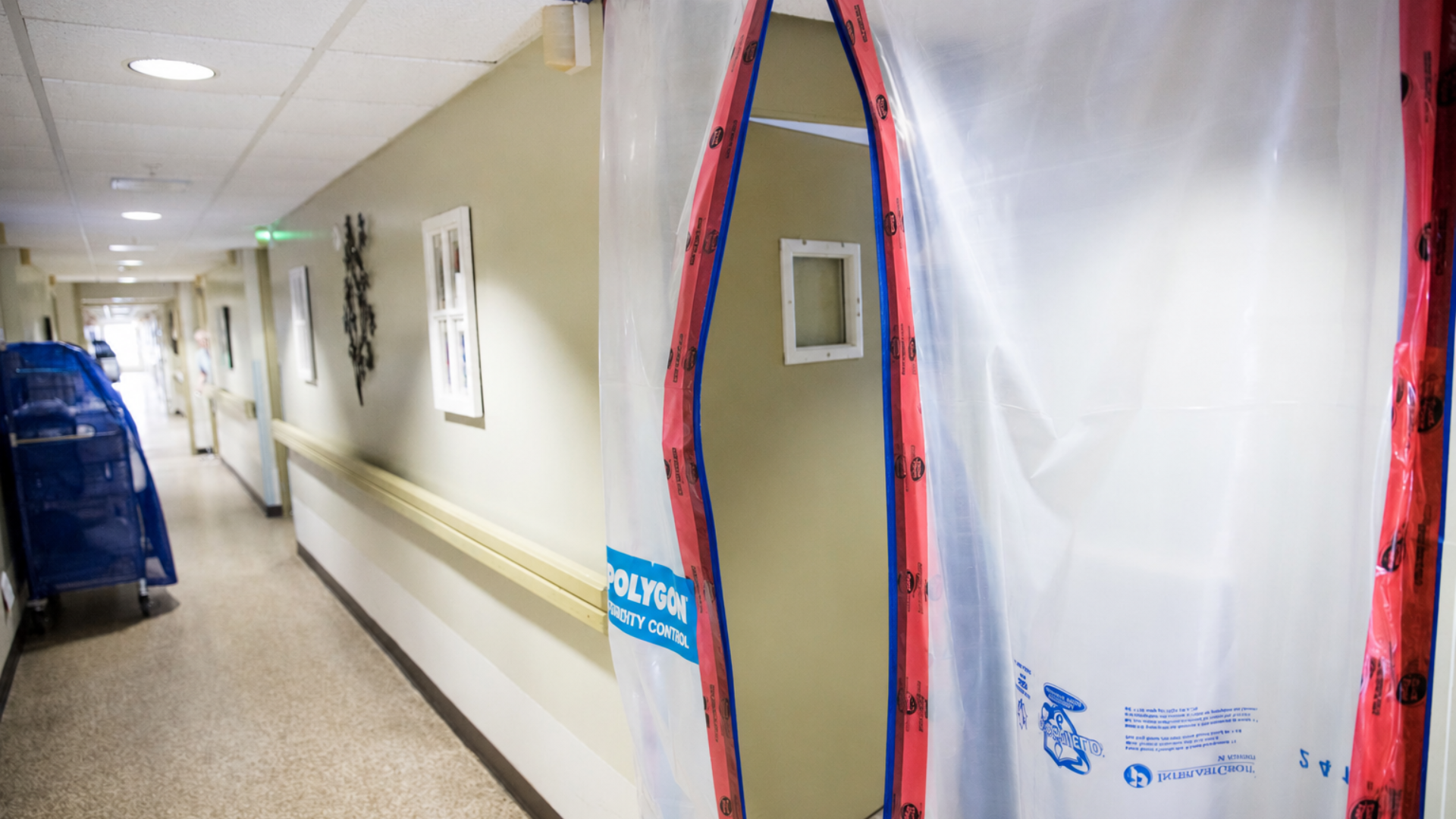
Cleaning, demolition, removal of damaged materials, drying, and reconstruction can affect indoor conditions as work progresses. Equipment may be moved, ventilation may change, and different areas of the building may be addressed at different stages of the project.
Remote monitoring can provide continuous data throughout this process, helping teams track changes, compare conditions between areas, and maintain a record of environmental conditions without relying solely on periodic site readings.
This can be particularly useful in larger, multi-unit, commercial, or partially occupied properties where restoration work may be taking place in one area while other parts of the building remain in use.
Indoor air quality testing and continuous monitoring can both provide useful information following a fire, although they serve different purposes.
Specialized testing may involve air or surface sampling and laboratory analysis when specific contaminants need to be investigated, or conditions need to be verified. The appropriate type of testing depends on the property, materials involved, extent of the loss, and applicable requirements.
Continuous monitoring provides another layer of information by tracking certain indoor environmental conditions over time. Remote sensors can monitor parameters such as:

Tracking these parameters over time can help identify trends, changes, and differences between areas of a building that may warrant further attention. Carbon dioxide is mainly an indicator of ventilation and occupancy. Carbon monoxide, where monitored, is the combustion-related gas. Continuous monitoring does not replace specialized sampling, laboratory analysis, or clearance testing where these are required. Instead, it can complement these activities by providing greater visibility into how indoor conditions change throughout the recovery process.

Emergency call 24hr service
1 888 702-4782Send message
ca_service@polygongroup.comDirect Reaction Team
We are ready to respond on short notice to ensure that real estate and other property restored to its origins in the fastest possible way. We do a quick assessment of the damage to be able to take the right actions
Please contact us with your questions or project requirements. We look forward to assisting you.
4565 Metropolitain Est, Montreal, QC, H1R 1Z4
Tel: 514-326-0555 | Fax: 514-326-1444
24/7 Emergency
1-888-702-4782