Notice
You are now leaving Polygon Restoration's website and will be directed to another country in the group.
Do you want to proceed?
Notice
You are now leaving Polygon Restoration's website and will be directed to another country in the group.
Do you want to proceed?

Repairing and restoring damaged surfaces instead of replacing could help reduce claim severity while supporting sustainability goals. In many property damage claims, cosmetic surface damage leads to the replacement of fixtures that remain fully functional.
Restoration specialists frequently encounter situations where a small chip, burn, crack, or scratch results in the removal of an entire bathtub, countertop, cabinet panel, or tile assembly.
From a restoration perspective, this raises an important question. Does the entire fixture truly need to be replaced? While replacement may appear to be the simplest solution, it often expands both the scope of the claim and its environmental footprint.
Replacing a damaged fixture rarely involves a single task. Demolition, disposal of materials, product sourcing, installation, and scheduling trades all add time and cost to the reconstruction process. Each additional step increases labour requirements and extends the timeline needed to close the claim.
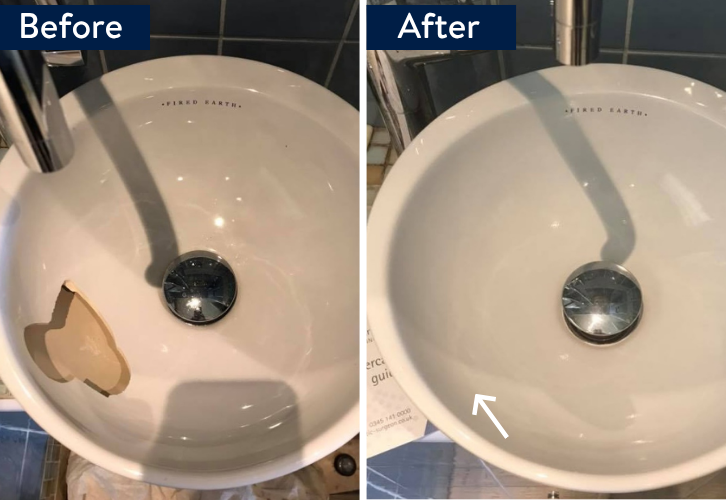
Surface Repair provides an alternative approach. Instead of removing and replacing entire fixtures, the damaged portion is restored onsite using specialized repair techniques and colour-matching systems that blend with the surrounding material, avoiding demolition, reducing labour requirements, and allowing many repairs to be completed within a few hours. For claims professionals, this often means faster resolution and a smaller overall claim scope.
Reducing claim severity remains one of the most effective ways to manage portfolio performance. Although large losses often draw the most attention, a significant share of claims involve smaller incidents that occur frequently. Surface damage claims fall squarely into this category. Chipped bathtubs, scratched countertops, damaged cabinet surfaces, or burned flooring are common issues following water damage, fire or smoke damage, tenant damage, or everyday accidents. When these fixtures are replaced rather than repaired, the cumulative cost across thousands of claims can become significant.
For claims professionals, repair-first solutions can also simplify the claims process. When fixtures are repaired rather than replaced, the need for sourcing materials, coordinating multiple trades, and scheduling extended restoration work is significantly reduced. This can help accelerate claim resolution timelines and streamline project management. In portfolios where similar types of surface damage occur frequently, incorporating repair as an option can contribute to more predictable repair scopes and more efficient claims handling. For property owners and occupants, the benefits are equally practical. Less demolition means less disruption, less debris, and fewer contractors entering the property. In environments such as multi-residential buildings, hotels, and student housing, minimizing downtime can be particularly valuable.
Sustainability commitments are becoming increasingly visible across the insurance industry. Many insurers are developing Environmental, Social, and Governance (ESG) strategies that focus on reducing emissions, improving operational efficiency, and supporting responsible resource use.
Repair offers a practical way to support these objectives. Restoring existing materials extends the lifecycle of fixtures that would otherwise be removed and replaced. It also reduces waste generated during restoration projects and avoids the emissions associated with manufacturing, transporting, and installing new materials.
Each repair that avoids replacement reduces construction waste while preserving materials that remain functional. By prioritizing repair where appropriate, restoration providers can also support insurers and property owners in advancing their environmental impact goals while maintaining efficient claims resolution. In this way, repair-first restoration strategies can help connect everyday claims decisions with broader sustainability goals.
The restoration industry has long focused on returning damaged property to its pre-loss condition. However, many claims processes still default to replacement when dealing with cosmetic surface damage.
As insurers and property stakeholders look for ways to manage rising repair costs and improve environmental outcomes, repair-first strategies are receiving increased attention. Surface Repair demonstrates how relatively small decisions within the claims process can create meaningful operational and environmental benefits. Addressing damage at the most localized level possible helps control claim severity, shorten repair timelines, and reduce waste.
For claims professionals, the question may increasingly be whether replacement is truly necessary, or whether a localized repair can restore the surface while limiting both the cost and environmental impact of the claim.

David McKeon, Branch Manager - Ontario
This article was originally published in Canadian Underwriter.

Emergency call 24hr service
1 888 702-4782Send message
ca_service@polygongroup.comDirect Reaction Team
We are ready to respond on short notice to ensure that real estate and other property restored to its origins in the fastest possible way. We do a quick assessment of the damage to be able to take the right actions
Please contact us with your questions or project requirements. We look forward to assisting you.
4565 Metropolitain Est, Montreal, QC, H1R 1Z4
Tel: 514-326-0555 | Fax: 514-326-1444
24/7 Emergency
1-888-702-4782