Notice
You are now leaving Polygon Restoration's website and will be directed to another country in the group.
Do you want to proceed?
Notice
You are now leaving Polygon Restoration's website and will be directed to another country in the group.
Do you want to proceed?
Custodians of libraries and archives prepare for emergency incidents that threaten their collections, both through writing emergency plans and training colleagues in their implementation, because they recognise the need to preserve collections through rapid response. Early incident control will limit the number of books and boxes that are affected by the peril and the severity of water penetration. Preparation in advance also ensures that a salvage operation can be established quickly, ensuring that affected objects are recovered and stabilised before secondary damage, such as mould growth, can take hold.
Keele University suffered a major leak in its top-floor plant room on a Saturday lunchtime – directly above the University Archives. Pre-existing emergency plans were quickly called into action to protect collections and minimise disruption to services.
The duty staff quickly identified the risk to readers, staff and initiated an evacuation of the library, and contacted the Library Emergency Team. As long-standing Priority Users, Polygon's Document Restoration team was contacted in the first 15 minutes for advice and arranged to attend the same afternoon.
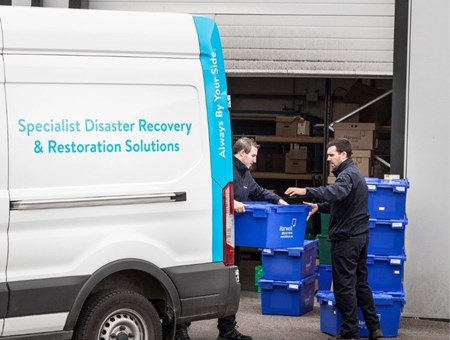
The University Estates Team took action to stop the leak and make the electrics safe so that polythene could be put up to protect archive boxes from further seepage of water. As Polygon arrived, this process was complete, and the process of extracting archive boxes with visible water damage from the evacuated reading rooms had begun.
Polygon's Project Manager further inspected the strong rooms and found that there had been some further seepage down the backs of cases, which was not immediately apparent and in the back of some wooden plan chests.
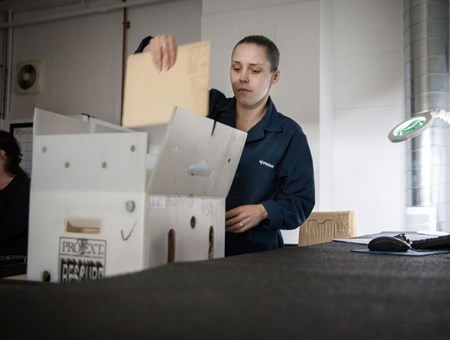
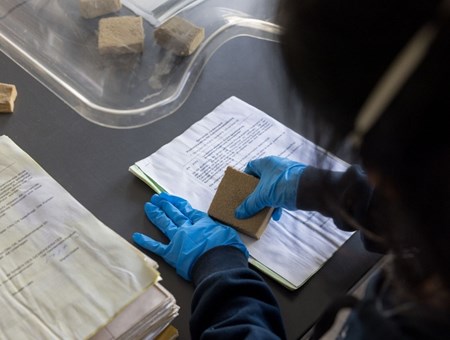
The library had a great team of salvage assistants who worked to remove all wet boxes that evening. Then, led by Polygon, a triage process was conducted to identify any items which, by reboxing or simply removing the wet box base or lid, could be protected.
After this initial triage process, the archive was reinspected, and advice was provided on the possibility of trapped water in the ceiling void and taking care of unaffected objects in an environment with elevated relative humidity, and dehumidification equipment was provided.
Due to the rapid response of the Library Team and the professional advice provided by Polygon's Document Restoration team, the physical damage to archives was minimal, even though thousands of litres of water had escaped from the mains pipe. It also meant that the library could reopen the following day, which was crucial given the timing of the incident so close to a major exam period on campus.
Although it was a challenging day, the combination of a pre-existing good quality emergency plan and the early engagement of a specialist contractor ensured that, despite a very serious incident, damage to collections was minimised.
Paul Reynolds, University Librarian at Keele, comments:
“The Library Emergency Team phoned Polygon, as we are a Priority User Service. Polygon's Project Manager immediately provided crucial advice and, reassuringly, remained in contact during her journey here. She arrived within 3 hours to assess the damage. The excellent emergency training already received from Polygon meant Library staff were quick to decant boxes and sheet over stacks with polythene. Even so, it was invaluable to have Polygon's knowledge and expertise on-site. Emma spent several hours triaging wet boxes and contents, inspected the site and advised on water damage to the building, box replacement and off-site storage; she remained sympathetic to balancing the needs of the archive with the need to reopen the Library quickly. A very useful written report with key recommendations was received that evening.”

Emergency call 24hr service
01480 442327Send message
uk_sales@polygongroup.comDirect Reaction Team
We are ready to respond on short notice to ensure that real estate and other property restored to its origins in the fastest possible way. We do a quick assessment of the damage to be able to take the right actions.
Your questions and comments are important to us. Select a topic and fill in the contact form. We´ve everything covered for your needs!
Polygon UK
Blackstone Road, Huntingdon, Cambridgeshire, PE29 6EE
Phone: 01480 442327
Email: uk_sales@polygongroup.com