Notice
You are now leaving Polygon Restoration's website and will be directed to another country in the group.
Do you want to proceed?
Notice
You are now leaving Polygon Restoration's website and will be directed to another country in the group.
Do you want to proceed?
Keeping bound volumes and archival collections free from dust contamination is a crucial part of any preservation strategy. Not only can such dust present a danger to health by triggering allergies or sensitising staff and users, but if conditions are suitable, accumulated dust can allow the germination and growth of mould spores on the substrate, and attract insect pests.
Surface debris commonly found on books can include particles such as pollens, mould spores, skin, degraded leather, as well as external contaminants entering through windows and doors, including pollutants from traffic.
A regular program of cleaning of collections for accumulated dust, together with robust quarantining procedures for new acquisitions, should be a key requirement in a special collections library to remove problematic deteriogens and maintain a pest-free environment.
The Special Collections service at Queen’s University Belfast provides access to the Library’s rare and early printed books, maps, and manuscripts collections, as well as to more modern material relating to Ireland and Ulster in particular.
All items held in Special Collection are considered to be of lasting research value and include examples of the earliest printed works, books and pamphlets published between the 16th and early 19th centuries. The McClay Library reached out to Polygon so that a quotation for the works could be provided.
A collections survey highlighted that approximately 19,000 volumes on roughly 900 shelves within one storage area would benefit from specialist cleaning. The majority of the volumes affected were leather-bound, including the library’s most important collections, the 19th and 20th-century book collection, as well as all volumes printed before 1701.
A site visit and survey were conducted by one of Polygon's Document Restoration project managers, where the levels of contamination were examined, and the logistics of the project were considered so that a project cost could be calculated.
Other considerations included that the library specified that the cleaning project should be conducted during the long summer vacation to minimise disruption to library users, and that the works should be conducted onsite in Belfast to ensure continued access to the collection for researchers.
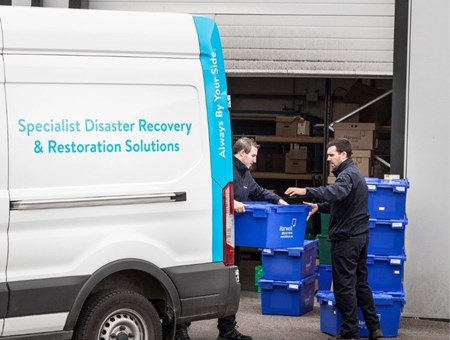
Polygon's specialist team proposed to conduct the works over a period of five weeks, with a team of people led by our External Project Manager.
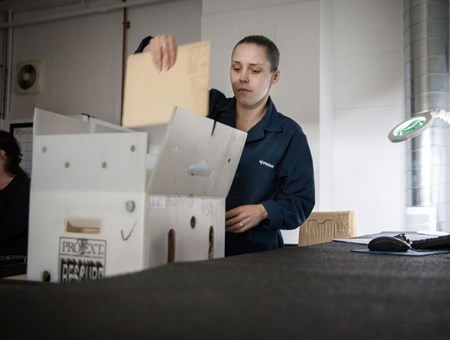
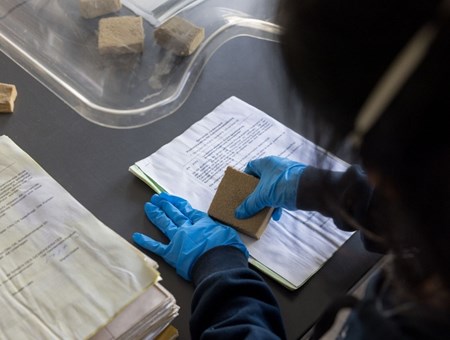
A combination of methodologies was utilised on this project, including adjustable suction HEPA vacuums with specialist tools, along with conservation brushes and sponges to achieve a successful outcome. Given the age of much of the material, sensitive and careful handling was essential throughout.
The project was completed within the time frame required, during Freshers’ Week, to the original budget, and to a standard that the library was delighted with.
Deirdre Wildy, Special Collections Librarian and Archivist at Queen’s University Belfast, comments:
“We are very happy with the work carried out by the Polygon's team here at Queen’s. The team fitted seamlessly into our environment, were unfailingly helpful and extremely pleasant to work with. Stuart is a real asset to your company – efficient, confident and thorough. I would have no hesitation in recommending Polygon's Document Restoration. Thank you so much for your assistance during the past months. It has been extremely helpful.”

Emergency call 24hr service
01480 442327Send message
uk_sales@polygongroup.comDirect Reaction Team
We are ready to respond on short notice to ensure that real estate and other property restored to its origins in the fastest possible way. We do a quick assessment of the damage to be able to take the right actions.
Your questions and comments are important to us. Select a topic and fill in the contact form. We´ve everything covered for your needs!
Polygon UK
Blackstone Road, Huntingdon, Cambridgeshire, PE29 6EE
Phone: 01480 442327
Email: uk_sales@polygongroup.com